
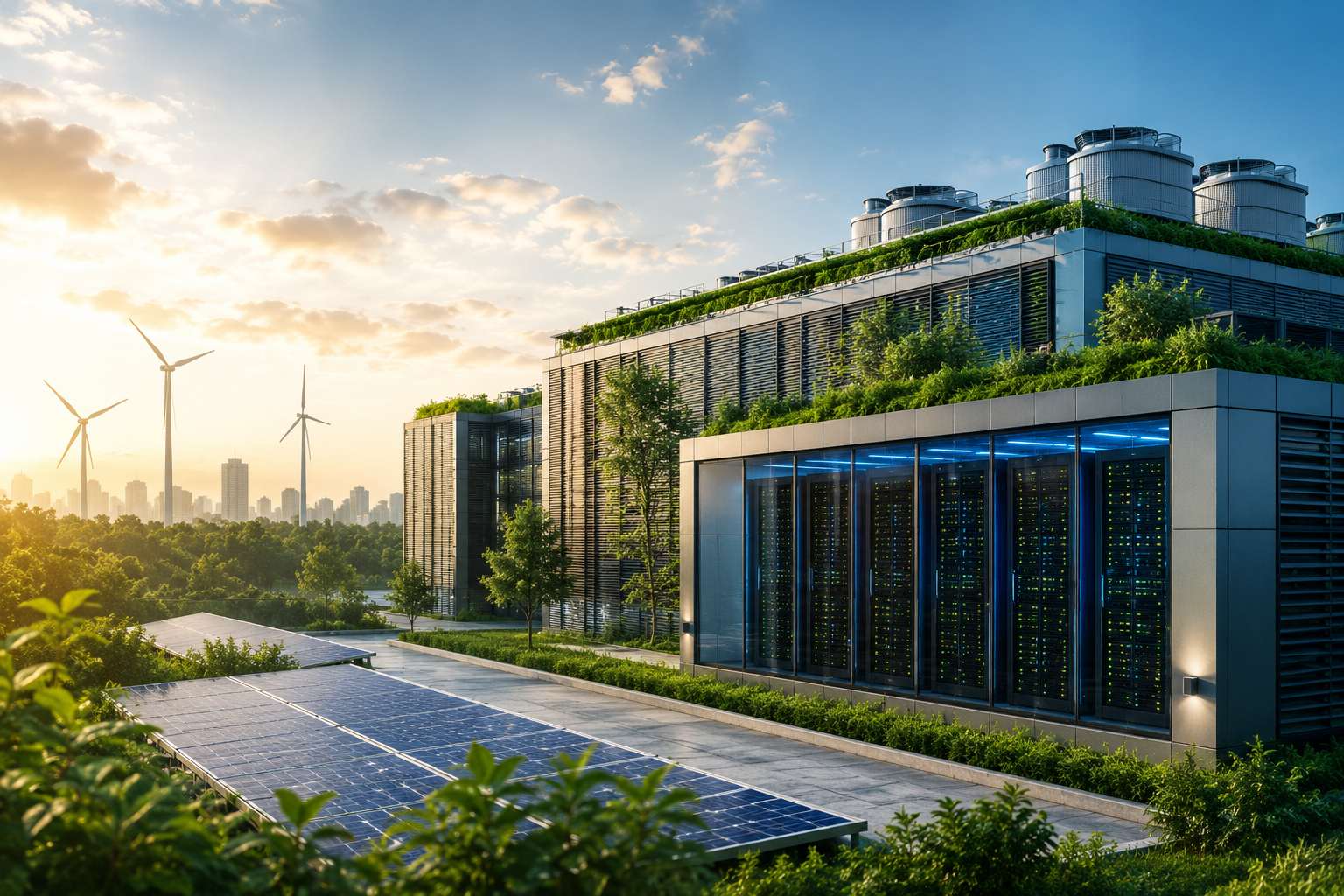
Introduction
As businesses increasingly rely on cloud computing, artificial intelligence (AI), big data, and digital services, the demand for data centres continues to grow at an unprecedented pace. While data centres serve as the backbone of the digital economy, they are also among the most energy-intensive infrastructure facilities in the world.
Today, organisations are seeking ways to balance operational performance with environmental responsibility. Sustainable data centres are emerging as the solution—combining advanced technologies, energy-efficient systems, and responsible engineering practices to reduce environmental impact while maintaining reliability and performance.
At AEPL, we believe that sustainable infrastructure is not just an industry trend; it is a necessity for the future of digital growth.
Understanding Sustainable Data Centers
A sustainable data centre is designed, constructed, and operated to minimise environmental impact while maximising operational efficiency. These facilities focus on reducing energy consumption, optimising cooling performance, conserving resources, and lowering carbon emissions without compromising uptime or reliability.
The goal is simple:
Improve energy efficiency
Reduce operational costs
Minimize environmental footprint
Enhance long-term infrastructure resilience
Support regulatory and sustainability goals
Why Sustainability Matters in Data Centers
Modern data centres consume significant amounts of electricity to power servers, networking equipment, and cooling systems.
Key challenges include the following:
High power consumption
Cooling-related energy usage
Carbon emissions from energy generation
Water consumption in cooling systems
Electronic waste management
As organisations commit to Environmental, Social, and Governance (ESG) goals, sustainable data centre practices are becoming a critical business requirement.
Energy-Efficient Power Infrastructure
Power infrastructure forms the foundation of every data centre. Sustainable facilities focus on maximising power efficiency while maintaining redundancy and reliability.
Best Practices
High-efficiency UPS systems
Intelligent power distribution units (PDUs)
Energy monitoring systems
Smart electrical infrastructure
Reduced transmission losses
Modern facilities continuously monitor power usage effectiveness (PUE) to optimise energy consumption and improve overall operational efficiency.
Precision Cooling: The Key to Sustainability
Cooling systems account for a substantial portion of data centre energy consumption. Efficient thermal management plays a critical role in reducing environmental impact.
Sustainable Cooling Solutions
Precision Air Conditioning Units (PAC)
CRAC and CRAH systems
Chilled water cooling systems
Hot aisle/cold aisle containment
Free cooling technologies
Liquid cooling solutions for AI workloads
Proper airflow management reduces hotspots, improves equipment performance, and significantly lowers cooling energy requirements.
The Rise of Liquid Cooling Technologies
The rapid growth of AI and high-performance computing is driving the adoption of liquid cooling systems.
Benefits of Liquid Cooling
Higher cooling efficiency
Reduced energy consumption
Improved rack density
Lower operating costs
Enhanced thermal performance
Technologies such as direct-to-chip cooling and immersion cooling are becoming increasingly important for next-generation data centre environments.
Renewable Energy Integration
Many leading data centre operators are investing in renewable energy to reduce their carbon footprint.
Renewable Energy Sources
Solar power systems
Wind energy procurement
Green power purchase agreements
Hybrid energy models
Battery energy storage systems
Integrating renewable energy helps organisations achieve sustainability targets while reducing dependence on conventional power sources.
Sustainable Construction Practices
Sustainability begins long before the first server is installed.
During the construction phase, responsible engineering and material selection can significantly reduce environmental impact.
Key Practices
Efficient use of construction materials
Waste reduction and recycling
Low-emission building materials
Water conservation measures
Sustainable site development
Green building design principles
At AEPL, sustainable construction practices are integrated into project planning and execution to support long-term environmental performance.
Intelligent Monitoring and Automation
Modern data centres utilise advanced Building Management Systems (BMS) and Data Centre Infrastructure Management (DCIM) platforms to improve operational efficiency.
Benefits
Real-time monitoring
Energy consumption tracking
Predictive maintenance
Automated cooling optimization
Improved resource utilization
Automation enables operators to make data-driven decisions that improve performance while reducing waste.
Water Conservation Strategies
Water usage is another critical sustainability consideration.
Conservation Measures
Closed-loop cooling systems
Water-efficient cooling technologies
Rainwater harvesting integration
Smart water monitoring systems
Reduced water wastage during operations
These strategies help reduce environmental impact while maintaining reliable cooling performance.
The Business Benefits of Sustainable Data Centers
Sustainability is not only beneficial for the environment—it also creates measurable business value.
Key Advantages
Lower operational costs
Reduced energy consumption
Improved infrastructure reliability
Enhanced regulatory compliance
Stronger ESG performance
Increased investor confidence
Future-ready infrastructure
Organisations that invest in sustainable infrastructure today are better positioned for long-term growth and resilience.
AEPL’s Commitment to Sustainable Infrastructure
At AEPL, sustainability is embedded in our approach to data centre, electrical, HVAC, civil, and infrastructure projects.
Our expertise includes:
Energy-efficient electrical infrastructure
Precision cooling systems
Airflow optimization solutions
Sustainable construction practices
Smart monitoring systems
Mission-critical infrastructure development
By combining engineering excellence with responsible infrastructure practices, we help clients build reliable, scalable, and environmentally responsible facilities.
Conclusion
As digital demand continues to accelerate, the future of data centres depends on balancing performance with environmental responsibility.
Sustainable data centres offer a pathway to lower energy consumption, reduced carbon emissions, improved efficiency, and long-term operational success. Organisations that embrace sustainability today will not only reduce their environmental footprint but also gain a significant competitive advantage in the years ahead.
The future of digital infrastructure is not only powerful—it is sustainable.
About AEPL
Abrasive Engineers Pvt. Ltd (AEPL) is a leading provider of data centre, telecom, civil, electrical, and HVAC infrastructure solutions across India. With extensive experience in mission-critical infrastructure projects, AEPL delivers reliable, scalable, and future-ready engineering solutions for enterprise clients nationwide