
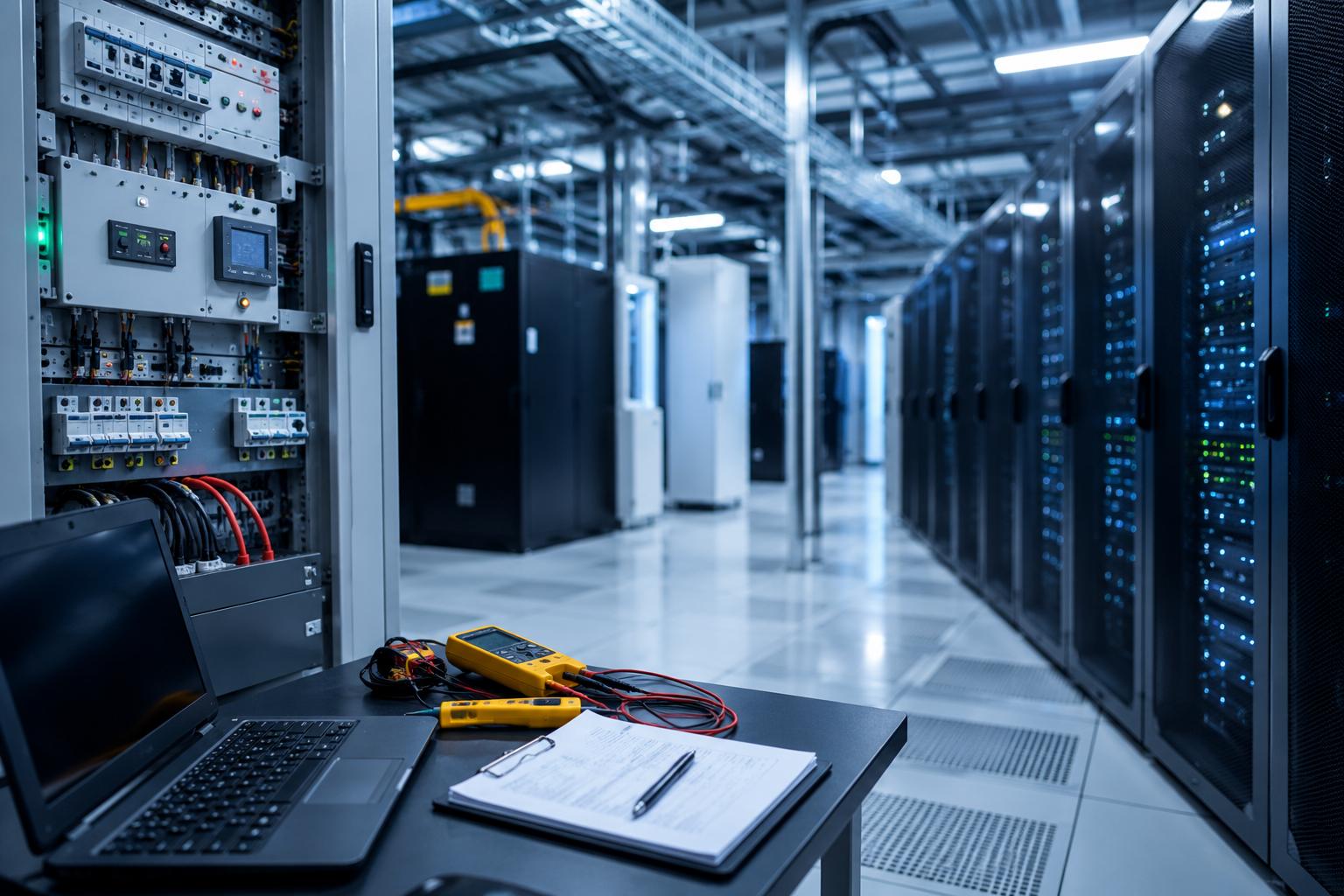
In today’s digital economy, data centers serve as the backbone of cloud computing, enterprise applications, telecommunications, financial services, and emerging technologies such as Artificial Intelligence (AI) and Machine Learning (ML). As organizations become increasingly dependent on uninterrupted digital operations, ensuring the reliability and performance of data center infrastructure has become more critical than ever.
One of the most important stages in any data center project is Integrated System Testing (IST). IST validates that all critical infrastructure systems work together seamlessly under real-world operating conditions before the facility becomes operational.
Without proper testing, even the most advanced data center can face unexpected failures, operational disruptions, and costly downtime.
What is Integrated System Testing (IST)?
Integrated System Testing (IST) is a comprehensive testing process performed before a data center goes live. It verifies the interaction and performance of all critical systems as a unified infrastructure rather than as individual components.
The objective is to simulate actual operating scenarios and confirm that every system responds correctly during normal operations, utility failures, emergency conditions, and redundancy transfers.
IST ensures that:
Power systems operate reliably during utility interruptions.
Cooling systems maintain required environmental conditions.
Monitoring and control systems communicate accurately.
Fire and safety systems respond as designed.
Backup systems activate without disruption.
All integrated systems perform according to design specifications.
Why IST is Critical for Data Centers
- Ensures Business Continuity
Data centers support mission-critical applications where downtime can result in significant financial losses and reputational damage.
IST validates that backup infrastructure such as UPS systems, generators, cooling systems, and control systems function properly during failures and transitions.
- Verifies System Integration
A modern data center contains multiple interconnected systems including:
HT/LT Electrical Systems
UPS Infrastructure
DG Backup Systems
HVAC and Precision Cooling
Building Management System (BMS)
Fire Detection & Suppression Systems
Security and Access Control
Network Monitoring Systems
Although each system may pass individual testing, IST verifies that they function correctly when operating together.
- Reduces Operational Risks
Early identification of integration issues helps prevent costly failures after commissioning.
IST allows project teams to:
Identify configuration errors
Validate control sequences
Detect communication failures
Correct operational inconsistencies
Improve system reliability
- Confirms Redundancy Performance
Most enterprise and hyperscale data centers are designed with N+1, 2N, or higher redundancy levels.
IST verifies that:
Redundant power paths function correctly
UPS systems transfer loads seamlessly
Backup generators start automatically
Cooling redundancy maintains environmental conditions
Failover operations occur without service interruption
Key Systems Included in IST
Electrical Infrastructure
Testing includes:
HT and LT Power Distribution
Transformers
Switchgear
UPS Systems
PDUs
Bus Ducts
DG Sets
Automatic Transfer Switches (ATS)
Cooling Infrastructure
Validation of:
Chillers
CRAC Units
CRAH Units
Cooling Towers
Pumps
Chilled Water Systems
Airflow Management Systems
Fire Protection Systems
Testing covers:
Smoke Detection Systems
VESDA Systems
Fire Alarm Panels
Gas Suppression Systems
Sprinkler Systems
Emergency Shutdown Functions
Building Management System (BMS)
Verification of:
Equipment Monitoring
Alarm Reporting
Control Logic
Environmental Monitoring
Trend Analysis
Security Systems
Testing includes:
Access Control Systems
CCTV Surveillance
Intrusion Detection
Visitor Management Systems
Typical IST Scenarios
During Integrated System Testing, several operational and emergency scenarios are simulated.
Utility Power Failure
The facility is tested to confirm:
UPS systems support critical loads
DG sets start automatically
Power restoration occurs without downtime
Generator Failure
Testing validates:
Backup redundancy
Automatic load transfer
Alarm generation and response
Cooling System Failure
Verification of:
Redundant cooling activation
Temperature control stability
Environmental compliance
Fire Alarm Activation
Simulation confirms:
Alarm generation
Equipment shutdown sequences
Emergency response coordination
Network and Monitoring Failure
Validation of:
Monitoring continuity
Alarm escalation procedures
System resilience
Benefits of Integrated System Testing
Improved Reliability
IST confirms infrastructure readiness before occupancy and production deployment.
Reduced Downtime Risk
Potential issues are identified and corrected before they affect operations.
Regulatory Compliance
Supports compliance with:
Uptime Institute Guidelines
TIA Standards
Client Specifications
Industry Best Practices
Enhanced Operational Confidence
Facility operators gain confidence that all systems will perform as expected under real-world conditions.
Faster Commissioning
Proper IST reduces post-handover issues and accelerates operational readiness.
Common Challenges During IST
While IST is critical, several challenges may arise:
Complex system interactions
Multiple vendor coordination
Incomplete documentation
Configuration mismatches
Communication protocol issues
Limited testing windows
Experienced project teams are essential to successfully plan, execute, and document IST activities.
AEPL’s Approach to Integrated System Testing
At Abrasive Engineers Pvt. Ltd. (AEPL), Integrated System Testing forms a vital part of our project delivery process.
Our teams ensure:
Comprehensive IST planning and execution
End-to-end system validation
Coordination with clients, consultants, and OEMs
Functional and performance testing
Detailed reporting and documentation
Compliance with project specifications and industry standards
From electrical infrastructure and HVAC systems to fire safety and monitoring platforms, AEPL ensures every component operates as a unified, reliable, and mission-critical ecosystem.
Conclusion
Integrated System Testing is one of the most important phases of any data center project. It bridges the gap between construction completion and operational readiness by validating that all systems function together under real-world conditions.
A successful IST program minimizes risk, improves reliability, enhances operational confidence, and ensures uninterrupted business continuity.
As India’s data center industry continues to grow rapidly, comprehensive testing and commissioning practices will remain essential for delivering resilient, scalable, and future-ready digital infrastructure.
Need Expert Support for Data Center Infrastructure Projects?
AEPL provides end-to-end Data Center, Civil, Electrical, HVAC, Telecom, Testing, and Commissioning solutions across India.
Contact our experts to discuss your next mission-critical infrastructure project.